



The key to setting ticket prices is finding the balance between financial sustainability and what your audience is willing to pay. That balance makes event ticket pricing one of the most critical decisions in the event planning stages. If you price your tickets too low, you may struggle to cover expenses. Price them too high, and you might not get enough attendees.
But event pricing doesn’t have to be guesswork. You can use a straightforward calculation process, backed by your budget and attendance goals, to build your pricing strategy.
This guide walks you through that process step by step, so you can price tickets with confidence rather than relying on instinct.
What Is An Event Pricing Strategy?
An event pricing strategy is the method you use to determine how much attendees should pay for admission, taking into consideration your event costs, revenue goals, expected attendance, audience demand, and market conditions.
Your pricing strategy should answer a few key questions about your specific event:
- What does it cost to produce this event?
- How many people do you realistically expect to attend?
- Does the event need to generate revenue? How much?
- How does your price compare to similar events?
- Are you offering enough value to justify the cost?
Pricing strategies are unique for each event and each organization. An industry conference may prioritize covering production costs. A community event might emphasize affordability to maximize participation. A fundraising gala may intentionally price tickets above the actual event cost knowing that attendees are also supporting the organization’s mission.
Factors That Determine Your Event Ticket Price
Before calculating prices, you’ll need to identify the variables that will influence them. These variables come in the form of:
Fixed Costs: Fixed costs stay relatively constant regardless of attendance. Whether 100 or 500 people attend your event, you’ll likely still pay these expenses. Examples include:
- Venue rental
- Audio/visual equipment
- Speaker/presenter fees
- Entertainment
- Event insurance
- Marketing
- Registration software
- Decor
- Permits
Variable Costs: Variable costs increase with each attendee. Knowing your per-person cost is critical because every additional attendee affects your overall budget. Examples include:
- Meals and beverages
- Name badges
- Printed materials
- Swag bags
- Transportation
- Per-person venue fees
Expected Attendance: Attendance estimates have a significant impact on pricing. It is crucial to be realistic. Being overly optimistic about attendance often results in underpriced tickets. While variable costs are much smaller than fixed costs, expecting 300 attendees at a $50/person variable cost and getting only 150 registrations at $50/person can dramatically reduce revenue.
Revenue Goals: Not every event has the same financial objective. Your pricing should reflect the primary objective. Examples of this include:
- Breaking even
- Generating surplus revenue
- Funding future programs
- Raising money for a cause
- Attracting new members
- Growing long-term community engagement
Audience Price Sensitivity: Consider who you’re serving. Students, volunteers, and local community members typically have budgets different from those of executives attending an industry conference. However, it is also important to remember that price isn’t just about affordability—it’s about perceived value. Attendees are generally willing to pay more when the event offers sought-after speakers, networking opportunities, exclusive experiences, continuing education credits, or unique entertainment.
Competitive Landscape: It is important to research similar events in your region and industry, because understanding the market helps ensure your pricing falls within a reasonable range. Compare more than just ticket prices. Be sure to consider other factors such as meals, venue quality, and speaker lineup.
How To Calculate Your Break-Even Ticket Price
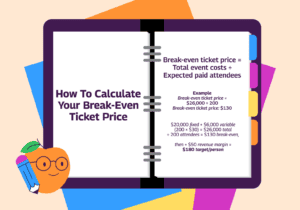
Your break-even ticket price is the minimum average ticket price needed to cover expenses.
The basic formula is:
Break-even ticket price = Total event costs ÷ Expected paid attendees
Imagine you’re planning an event and your fixed costs come out to $20,000, and your variable costs amount to $30/person. Let’s say you expect 200 guests, so your total variable cost (200 x $30) is $6,000. That puts your total event cost (fixed + variable) at $26,000.
So, for this example:
Break-even ticket price = $26,000 ÷ 200
Break-even ticket price: $130
The next step would be to add a revenue margin. If your goal is to generate a surplus; factor that into the calculation.
In keeping with the above example, suppose you’d like to raise $10,000 for future programming.
$10,000 / 200 attendees = $50
Therefore, your new target ticket price would be $130 (break-even) + 50 = $180/person
Note: Not every attendee pays the same amount. If you offer discounted early bird tickets and premium VIP packages, focus on your average ticket revenue. If your Early Bird discount takes off $25, then you’ll want to factor that deficit in on the other ticket tier options.
Tiered Pricing: Early Bird, General, And VIP
Tiered pricing allows you to offer different ticket options while encouraging earlier registrations and serving different audience preferences.
- Early Bird Pricing: Early bird discounts reward attendees who register well before the event. Attendees get a discount, and the organization gets earlier cash flow, better attendance forecasting, and reduced last-minute uncertainty.
- General Admission: The standard ticket price after the early bird period ends.
- VIP Packages: VIP tickets can boost revenue by offering added value components, such as reserved seating, meet & greets, swag packages, and exclusive receptions.
- Group Discounts: Conferences and association events often utilize group pricing. While the price per ticket decreases, total registrations often increase.
Special Considerations For Fundraising And Nonprofit Events
Fundraising events introduce an additional layer to pricing because a ticket may include both the value of goods and services received and a charitable contribution.
For example, suppose a nonprofit gala ticket costs $250 and includes dinner, drinks, and entertainment with a fair market value (FMV) of $90. In many cases, only the remaining $160 may qualify as a charitable contribution for tax purposes, assuming applicable tax rules are met, and no other benefits affect the calculation.
That makes it important to determine the FMV of what attendees receive. Common items that contribute to FMV include:
- Meals and beverages
- Entertainment
- Venue-related experiences
- Gift bags or merchandise
- Wine tasting packages
- Admission to exclusive activities
Be sure to clearly communicate the deductible portion of the ticket on receipts and donor acknowledgments. Because tax rules can be nuanced, nonprofits should work with their accountant or legal advisor to ensure their calculations and acknowledgments comply with IRS requirements.
Tip: Remember, ticket sales are not the only revenue stream at fundraising events. Sponsorships, auctions, raffles, paddle raises, and donations can also generate a significant percentage of total revenue.
Common Event Pricing Mistakes To Avoid
Pricing should start with your financial model, not a number that feels competitive. Avoid these common pitfalls.
-
- Do not guess. Do the math and budget.
- Do not ignore variable costs. Do remember that every attendee has a cost associated with them.
- Do not overestimate attendance. Do build realistic projections using historical data.
- Do not wait too long to open registration. Do make registration available early to gauge demand.
- Do not offer too many ticket types. Do provide a few clearly defined options.
- Do not forget about additional fees. Do factor payment processing fees, registration platform fees, taxes (where applicable), and service charges in your calculations.
- Do not forget to review the results after the event. Do compare attendance, revenue by ticket type, and unforeseen costs to improve your pricing strategy over time.
Tools To Manage Event Pricing And Registration
The right event technology can make pricing much easier to manage, especially when you’re offering multiple ticket tiers or expecting hundreds of attendees.
Look for registration software that supports:
- Easy registration
- Group registrations
- Waitlists
- Mobile-friendly registration
- Automated confirmation emails
- Pricing and payments
- Multiple ticket types and pricing levels
- Early bird pricing with expiration dates
- Discount codes
- Payment processing
- Reporting and analytics
- Real-time registration reporting
- Integration with your CRM or donor management system
- Financial reporting and revenue tracking
The software will help you execute your pricing strategy accurately, track sales as they happen, and provide the data you need to refine your approach for future events.
Tip: Wild Apricot can help with all your online event registration needs. Contact us today!
Frequently Asked Questions
How do I calculate the right ticket price for my event?
Start with your break-even ticket price: the minimum average ticket price needed to cover expenses. Break-even ticket price = Total event costs ÷ Expected paid attendees.
What’s the difference between fair market value and a charitable contribution for event tickets?
Fundraising event ticket pricing may include both the value of the event ticket and an added charitable contribution. For example, if a nonprofit gala ticket costs $250 and includes dinner, drinks, and entertainment with a fair market value (FMV) of $90, only the remaining $160 may qualify as a charitable contribution for tax purposes. It is important to clearly communicate the deductible portion of the ticket on receipts and donor acknowledgments when required.
Should events use tiered ticket pricing?
Tiered pricing allows you to offer different ticket options while encouraging earlier registrations and benefiting different audience segments. Doing so helps you gauge interest earlier (Early Bird tickets) or offer higher-priced options for those seeking an elevated experience (VIP tickets).
What’s a good ROI for an event?
The most basic formula is: ROI = Event Revenue / Event Expenses. For example, if your event brought in $50,000 in revenue and cost $25,000 to run, the ROI would be 2.0. That means you earned two dollars for every one dollar spent. Check out this complete guide to understanding your event’s ROI to learn more!
How do early bird discounts affect event revenue?
Early bird discounts reward attendees who register well before the event. The discount should be meaningful enough to encourage early action without significantly reducing your average ticket revenue. Attendees get a discount, the organization can better forecast attendance, secure cash flow earlier,, and reduce last-minute uncertainty.