

A nonprofit code of ethics does more than put good intentions on paper; it gives board members, staff, and volunteers a shared standard for decision-making when the right course of action isn’t always obvious. A code of ethics can also reinforce public trust by demonstrating how the organization expects people acting on its behalf to handle conflicts, resources, confidential information, fundraising, and relationships with the people it serves.
What Is A Nonprofit Code Of Ethics?
A nonprofit code of ethics is a written statement of the values and standards that guide how an organization’s board, employees, and volunteers are expected to conduct themselves.
Start by pinpointing your organization’s mission and values, identifying the behaviors that support those values, and then building a practical document around those principles.
Your code should establish principles rather than attempt to predict every possible situation. Think of the code as a framework for answering questions such as, “What does responsible stewardship of charitable resources look like?” and “How should board members and staff handle confidential information?”
Why Every Nonprofit Needs a Code Of Ethics
A code of ethics creates a common standard for people who represent the organization, brokering further trust between your nonprofit and the community you serve.
Your code of ethics should establish a culture of accountability. It tells people what the organization values and gives them a shared reference point when circumstances become complicated.
How To Create A Nonprofit Code Of Ethics: Step By Step
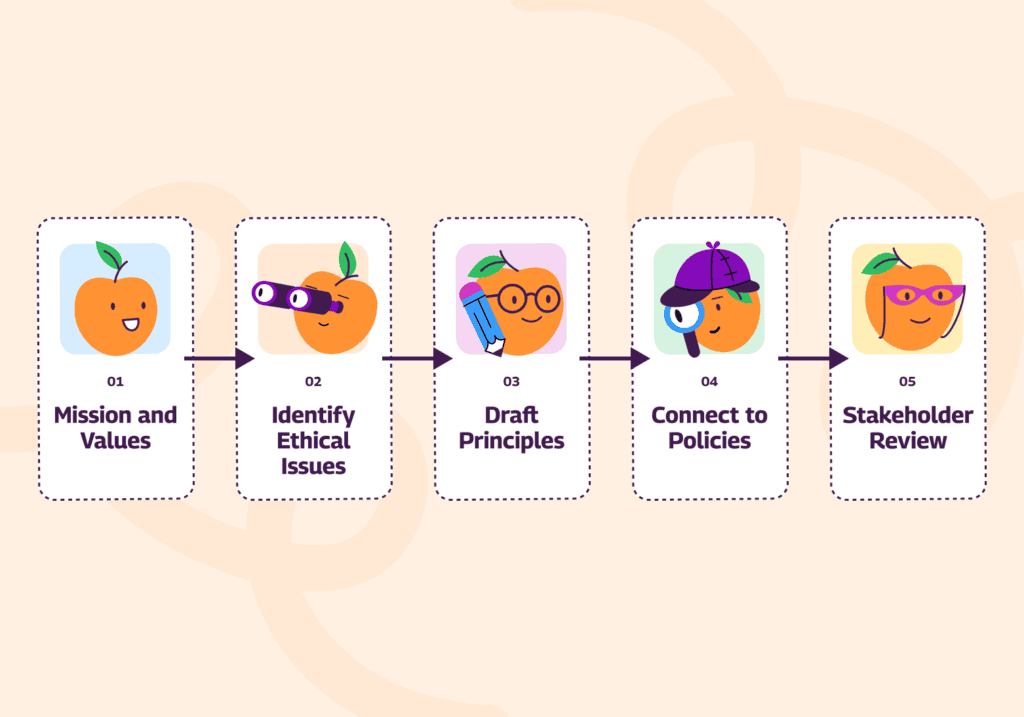
Your staff, board, and volunteers will face judgment calls no policy manual anticipates. A code of ethics gives them a shared standard to work from before those moments arrive. Building one takes a few deliberate steps, starting with what your organization already stands for.
Step 1. Start With Your Mission And Values
Before writing policy language, identify the values the code should reinforce.
Review your mission statement, values statement, strategic plan, bylaws, and other governance policies, using those values as the code’s foundation.
Step 2. Identify the Ethical Issues Most Relevant to Your Nonprofit
Conduct a basic ethics review and evaluate the situations your organization actually faces.
If your nonprofit handles sensitive client information, you may need to emphasize confidentiality and privacy more. If your nonprofit relies heavily on fundraising, you might focus more on donor relationships and honest communication.
Step 3. Draft Principles, Not a Lengthy Rulebook
Once you’ve identified your priorities, turn them into explicit expectations. Rather than creating a rule for every possible situation or conflict, set expectations for accurate representation of the organization in every instance, regardless of specifics.
Keep the language understandable to someone who has never served on a nonprofit board. If a board member or volunteer cannot easily explain what a provision means, the code probably needs simplification.
Step 4. Connect The Code To Existing Policies
A code of ethics should not operate on its own. It should connect to the policies that provide specific procedures.
Common companion policies include:
- Conflict of interest
- Whistleblower protection
- Document retention
- Gift acceptance
- Confidentiality and data privacy
- Harassment and discrimination
- Fundraising and donor communications
Step 5. Have the Right Stakeholders Review
The board should not be the only people involved in the review if the code will apply to the entire organization. Ask representatives from different parts of the organization to review the draft. Staff can identify practical situations the board may not encounter, while volunteers and program-facing employees may raise questions about relationships with clients, donors, or the community.
However, don’t overcomplicate or over rotate the review process. The goal is not to achieve endless consensus, but to instead make sure the document reflects how the organization actually operates with representatives among various perspectives.
What To Include In Your Code Of Ethics
The exact structure will vary, but most nonprofit codes benefit from addressing several core areas.
- Mission and Public Benefit: Explain the expectation that decisions and actions support the organization’s mission and the people or communities it serves.
- Integrity and Honesty: Establish expectations for truthful communication, responsible representation of the organization, and ethical professional conduct.
- Respect and Inclusion: Address how board members, staff, volunteers, donors, partners, and people served by the organization should be treated.
- Stewardship of Resources: Clarify that charitable funds, property, information, and other resources are used responsibly and for their intended purposes.
- Conflicts of Interest: State the expectation that actual or potential conflicts are disclosed and managed according to the organization’s conflict-of-interest policy. The National Council of Nonprofits recommends written procedures for disclosure and preventing interested board members from voting on matters involving their conflicts.
- Confidentiality and Information: Address responsible handling of private information belonging to donors, employees, clients, program participants, and other stakeholders.
- Fundraising and Communications: Establish expectations for honest fundraising, accurate public statements, appropriate donor relationships, and responsible use of the organization’s name.
- Compliance and Accountability: State that people representing the organization are expected to follow applicable laws and organizational policies and to raise concerns when they encounter conduct that may violate those standards.
- Addressing Concerns: Explain, at a high level, how someone can report an ethical concern and what happens after a concern is raised. The code does not need to contain a detailed investigation procedure if that process belongs in another policy.
The final document may be only a few pages. Brevity helps if it makes the code readable, memorable, and usable.
Getting Board Buy-In and Adoption
The board should own the final code because ethical conduct is ultimately a governance issue. Even with the board giving final approval, both its members and your staff should be involved in its development.
Rather than sending a finalized document to your board for a quick vote, build discussion of your organization’s values and the situations the code is intended to address into the process from the beginning. These conversations turn the code from an abstract document into a governance tool.
Communicating Your Code Of Ethics To Staff And Donors
Adoption is only the beginning. A code that lives in a board portal or employee handbook and is never discussed will have limited value.
Introduce the code during board and staff orientation, and explain why the organization created it. Managers and board leaders should model the behavior the code describes. If a difficult situation arises, leaders can refer back to the organization’s stated principles rather than treating the code as something that exists only for compliance purposes.
The objective is transparency. Your donors and community members should be able to see that your nonprofit takes stewardship, accountability, and ethical conduct seriously.
Reviewing and Updating Your Code Over Time
A code of ethics should evolve as the organization does. Set a regular review cycle—often annually or every few years—and review the code alongside related governance policies. Also revisit it after major organizational changes, such as a new executive director, significant program expansion, changes in fundraising practices, or adopting new technology that creates new privacy or information-management concerns.
The most important measure of a code is whether people use the code of ethics when making real decisions.
Your code of ethics should make governance easier, support responsible decision-making, and address any concerns that arise. If your nonprofit is ready to formalize those practices, membership management software can keep the code, related policies, meeting records, and related tasks organized in one place.
Tip: Look for tools that support document management, board communications, policy tracking, and secure access.
FAQs:
What’s the difference between a code of ethics and a code of conduct?
A nonprofit code of ethics is a broad account of the values and standards that guide how an organization’s board, employees, and volunteers are expected to conduct themselves. A code of conduct is a specific set of rules that tells people what they can and cannot do.
Is a nonprofit code of ethics legally required?
It is not legally required. Ethical decision-making often involves questions that legislation cannot answer.
Who should be involved in writing a nonprofit code of ethics?
Your nonprofit’s board should own the final code because ethical conduct is ultimately a governance issue. However, board members and staff should both be involved in developing your nonprofit code of ethics. These conversations turn the code from an abstract document into a governance tool.
How often should a nonprofit review its code of ethics?
A code of ethics should evolve as the organization does. Set a regular review cycle—often annually or every few years—and review the code alongside related governance policies. Also revisit it after major organizational changes, such as a new executive director, significant program expansion, changes in fundraising practices, or adopting new technology that creates new privacy or information-management concerns.
Should a nonprofit publish its code of ethics publicly?
Absolutely! Transparency is the key objective. Donors and community members should be able to see that your nonprofit takes ethical conduct seriously.