
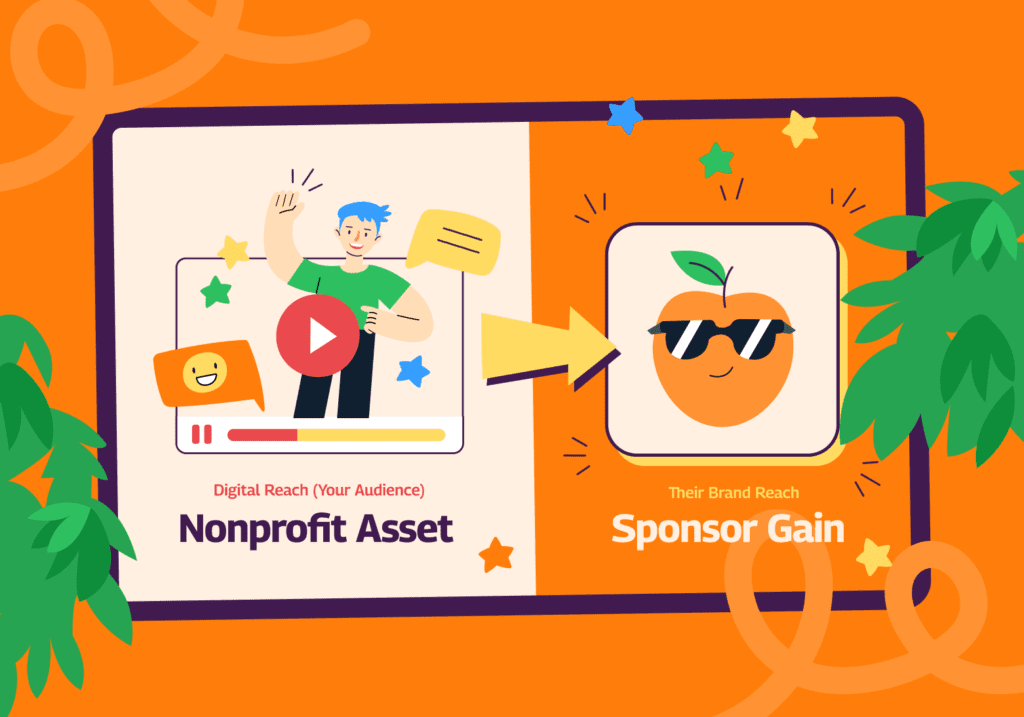
You need money. A local business wants exposure. Somewhere in the middle of those two facts lies one of the most powerful relationships in the nonprofit world: sponsorship.
But knowing that sponsorships exist and landing them are very different skills. Every year, thousands of well-meaning nonprofits send generic pitch emails, build sponsorship packages that feel like invoices, and wonder why companies keep saying no.
This guide is the antidote. Whether you’re learning how to get sponsors for an event next month or building a year-round corporate sponsorship program for your nonprofit, you’ll find a do-this-next playbook here — from asset analysis to closing the deal, including the ROI math sponsors actually want to see and the activation ideas that make packages irresistible.
What Is a Sponsorship?
A sponsorship is when a company commits money or resources to a nonprofit event or program in exchange for specific promotional benefits.
Unlike a donation, which is a one-way gift, a sponsorship is a business transaction. The company gives something (money, products, or services), and in return, it receives something valuable: access to your audience, brand visibility, and the goodwill that comes from being publicly associated with a cause.
Think of it as a marketing partnership with a mission layer. The sponsor gets brand awareness and a positive association. You get resources to do your work. Done right, it’s one of the most mutually beneficial relationships in fundraising.
What sponsors typically receive:
- Logo placement on banners, T-shirts, brochures, and digital materials
- Recognition in email newsletters and social media posts
- Speaking opportunities or booth space at events
- Access to post-event reports and audience data
- Association with a trusted mission-driven brand
Why Sponsorships Matter for Nonprofits
Fundraising diversification isn’t a nice-to-have — it’s a survival strategy. Nonprofits that rely too heavily on grants or individual donations are one budget cycle away from crisis. Sponsorships solve this in several ways:
Predictable, scalable revenue. Once you build a sponsor roster, renewals become easier than first-time acquisitions. A sponsor who had a great experience is dramatically more likely to say yes next year — often without a full pitch cycle.
Unrestricted or lightly restricted funds. Unlike many grants, corporate sponsorship dollars can often cover operating costs, staff time, and overhead — the expenses that grants often exclude.
Brand amplification. Your sponsors promote you when they promote themselves. A sponsor who puts your logo in their email newsletter, trade show booth, or social feed extends your reach into audiences you’d never touch otherwise.
Credibility by association. When a respected local company puts its name behind your event, it signals legitimacy to attendees, donors, and the media. For newer organizations, this third-party endorsement is highly valuable.
Non-cash resources. In-kind sponsorships — venue space, catering, printing, tech tools — can slash your event budget as effectively as a cash check would.
A strong sponsorship program doesn’t just fund your events. It builds your organization’s network, reputation, and long-term financial strength.
Types of Sponsorships
Sponsorship isn’t one-size-fits-all. Understanding the different types of sponsorships lets you design packages that appeal to a wider range of partners — and opens the door to companies that might not have a big cash budget but have plenty of other value to offer.
Financial / Cash Sponsorship
The classic form: a company writes a check (or sends a wire) in exchange for defined promotional benefits. Cash sponsorships are the most flexible because the money can go wherever you need it most. They’re also the most competitive to land, which is why the rest of this guide exists.
Cash sponsorships are tiered — Gold, Silver, Bronze — with benefits scaled to the investment level. We’ll cover how to build and price those tiers in a later section.
In-Kind Sponsorship
In-kind sponsorships involve contributions of goods or services rather than cash. The strategic value is the same — a $2,000 catering in-kind is equivalent to a $2,000 cash sponsorship used to pay a caterer — but the conversation is usually easier because you’re not asking a company to write a check.
Common in-kind sponsorship examples:
- Venue partner — provides event space at no cost or a deep discount
- Catering or beverage sponsor — covers food and drink for your event
- Printing sponsor — produces your programs, banners, and signage
- Technology sponsor — provides AV equipment, a ticketing platform, or event app
- Prize sponsor — donates items for raffles, auctions, or giveaways
When you pitch in-kind sponsorships, always express the value in dollar terms. “We’d love XYZ Printing to sponsor our signage package, valued at $800.” This makes it easy to place them in the right sponsorship tier.
Media Sponsorship
A media sponsor trades coverage for recognition. This might be a local TV station that runs a promotional segment, a newspaper offering ad placements, a radio station doing live mentions, or a podcast dedicating an episode to your event.
Media sponsorships are particularly powerful for awareness events — charity runs, galas, festivals — where broad public visibility is a goal, not just a perk. When you approach media partners, lead with audience overlap: “Your listeners are exactly the people who attend and support our event.”
Promotional Partner Sponsorship
A promotional partner uses their platform to amplify yours. This could be a social media influencer, a community blogger, a Chamber of Commerce, or an aligned nonprofit that cross-promotes your event to their audience.
These partnerships often involve no cash at all — it’s a mutual value exchange. You feature their brand, they promote your event. The ROI for both sides has been achieved.
Experiential Sponsorship
Experiential sponsorships are among the fastest-growing categories in event sponsorship, and for good reason: they create memorable moments that attendees associate directly with the sponsoring brand.
Rather than just slapping a logo on a banner, an experiential sponsor activates at your event. Examples include:
- A running shoe company sponsoring a warm-up station with branded foam rollers and trainers
- A coffee brand sponsoring a “morning recharge lounge” with free espresso and branded cups
- A tech company sponsoring a live charging station with their product on display
- A local brewery sponsoring a hospitality tent with their craft beers featured
- A health insurer sponsoring a meditation zone between sessions at a conference
Experiential sponsorships command premium prices because they generate organic social media content (attendees post photos) and create durable brand recall. When you’re building sponsorship packages, include at least one experiential activation option — even at smaller events, it differentiates your offer.
Tech / Digital Sponsorship
As events have evolved, so have sponsorship opportunities. Tech and digital sponsorships are now a distinct category that many nonprofits underutilize:
- Event app sponsor — logo and branding throughout a mobile event guide
- Live stream sponsor — logo shown during virtual or hybrid event broadcasts
- Wi-Fi sponsor — the network name is “EventName_SponsorBrand”
- Hashtag or social media activation sponsor — branded frame or filter for attendee photos
- Email marketing sponsor — branded placement in pre- and post-event communications
- Virtual background sponsor — for hybrid events, a branded Zoom background
Digital sponsorships are especially appealing to tech-forward companies and startups because they reach a digitally engaged audience. They’re also measurable — you can report click-through rates, impressions, and engagement data that traditional signage can’t provide.
A Real Sponsorship Example: The Boston Marathon
If you want to see how sponsorships are executed at the highest level, look no further than the Boston Marathon, organized by the nonprofit Boston Athletic Association (BAA). The event has maintained long-term corporate partnerships — including Adidas, John Hancock, and others — because it delivers measurable value to both sides.
Here’s the partnership in practice:
What the BAA gets:
- Millions of dollars in cash and in-kind sponsorship that fund operations, prize money, athlete support, and course management
- Brand credibility through association with globally recognized companies
- Resources to grow the event year over year
What Adidas gets:
- Direct access to hundreds of thousands of runners — their ideal customers — plus millions of global spectators
- Co-branding rights on official race apparel, one of the most visible consumer products in the running world
- Association with a distinguished event that carries deep emotional resonance for athletes
The sponsorship works because each party brings something the other genuinely needs. The BAA has the audience and the prestige. Adidas has the budget and the product relevance. Neither could replicate what the other provides.
Here’s the important takeaway for your organization: you don’t need the Boston Marathon’s scale. The same logic applies to a local 5K, a gala for 200 guests, or a member conference. You have an audience that some companies want to reach. Your job is to find them and make the value case compelling.
Mistakes That Lose Sponsors
Every experienced sponsorship professional has a graveyard of deals that should have closed but didn’t. Most of those losses trace back to the same handful of avoidable mistakes. Study this list before you send a single pitch:
- Pitching too late.Most companiesfinalize their annual sponsorship budgets in Q4. If you’re approaching sponsors in January for a March event, the money is likely already allocated. Start prospect outreach 6–12 months before your event and build relationships before you need the check.
- Leading with your needs, not their gains.“We need $5,000 to cover our event costs” is not a pitch —it’s a confession. Every communication with a prospect should be framed around what they receive: audience access, brand visibility, and community goodwill. Your needs are irrelevant to their decision.
- Sending a generic sponsorship deck.A one-size-fits-all PDF that lists your tiers and logos tells a sponsor nothing about why this partnership makes sense for their business specifically. Personalize at least the opening page and the framing of your audience data for every major prospect.
- Targeting the wrong person.Sending a sponsorship proposal to the wrong inbox is the most efficient way to waste everyone’s time. A request that lands with the CEO when the marketing director owns the budget, or with a junior coordinator who has no authority, will never reach the decision-maker. Do the research.
- Disappearing after the check clears.Sponsorsaren’t ATMs. If you cash the check, fulfill the contracted benefits, and send a generic thank-you email, you’ve completed a transaction, not built a partnership. Sponsor retention requires post-event impact reports, proactive communication, and genuine relationship management.
- Over-promising and under-delivering.It’stempting to inflate attendance projections or social media reach to close the deal. Don’t. A sponsor who pays for 500 attendees and sees 200 won’t renew. Accurate projections with clear methodology build trust that survives the occasional bad year.
- Ignoring the small yes.Many nonprofits only pursue title or headline sponsors and ignorethe smaller in-kind or bronze-level deals. But a roster of smaller sponsors adds up financially, reduces dependency on any single partner, and creates a track record that makes bigger asks easier next year.
- Failing to followup. A prospect who doesn’t respond to your first email isn’t saying no — they’re saying nothing yet. A polite, value-adding follow-up (“I thought this audience report might be useful as you’re evaluating”) is expected and appropriate. Give up too early, and you leave deals on the table.
How to Find Sponsors
Start with an Asset Analysis
Before you can convince a sponsor to invest in you, you need to know what you’re selling. An asset analysis is an honest inventory of everything your organization has that a business partner might find valuable.
Common sponsorship assets include:
- A recurring event with stable or growing attendance (walk, run, gala, conference)
- A large, engaged email list or membership base
- A social media following with high engagement rates
- A demographically defined supporter base (e.g., women 35–54, outdoor enthusiasts, parents with young children)
- A prominent physical location — a building, park, or high-traffic venue
- Media coverage history — past press mentions or broadcast segments
- Respected brand recognition in your community or sector
- Existing vendor and supplier relationships
- A compelling, emotionally resonant mission
Be specific. “Large social following” is less useful than “Instagram audience of 4,200 with 8.4% average engagement.” Specificity signals professionalism and makes your pitch harder to discount.
TIP: Your most underrated asset is often an existing company relationship. A CEO who personally donates to your cause, a vendor who has worked with you for years, a board member’s employer — these “in hand” relationships close faster than any cold outreach campaign.
Where to Look: Supporters, Vendors, LinkedIn & Referrals
Think of your prospect universe as three concentric circles:
Circle 1 — Supporters (Bull’s-Eye): Companies that already have a financial relationship with your organization. A corporate donor, an event sponsor from two years ago, a business whose owner serves on your board. These companies trust you. Start here — always.
Circle 2 — Contacts: Companies you know, but that haven’t given money. Your vendors (printer, caterer, AV company), your board members’ employers, and local businesses where your staff or volunteers are regular customers. They know your name, which cuts your credibility gap in half.
Circle 3 — Suspects: Companies with no existing relationship, but strong strategic alignment. This is the hardest circle to crack — but it’s also the largest universe. Research tools like LinkedIn Sales Navigator, local business journals, and Chamber of Commerce directories are your friends here.
Practical places to build your suspect list:
- LinkedIn — search for companies in your area by industry, then identify the right contact (usually Marketing Manager, Community Relations Manager, or Director of Communications)
- Local business journals — most publish an annual “Book of Lists” that ranks businesses by revenue, employees, and sector
- Chamber of Commerce member directories — pre-qualified local businesses with demonstrated community interest
- Competitor events — who is sponsoring similar events in your sector or market? They’ve already proven their willingness to spend on your kind of audience
- Your own attendee and donor list — do any of your supporters work at companies you haven’t approached? Ask for a warm intro
Defining and Framing Your Audience
Your audience is your most valuable asset to a sponsor. Everything else in your pitch — your mission, your history, your package — matters less than this: can you prove you have access to people they want to reach?
The mistake most nonprofits make is describing their audience in mission-speak: “passionate supporters of environmental conservation.” That’s meaningful to donors, not marketing departments. Sponsors need you to translate.
Build an audience profile that speaks the language of marketing:
| Data Point | What to Pull and Where to Find It |
| Demographics | Age, gender, location, HHI, education — from membership database, post-event surveys, or email platform analytics |
| Psychographics | Values, interests, purchase behaviors — from survey questions and engagement data |
| Digital reach | Email list size + open rate, social followers + engagement rate, website monthly visitors (Google Analytics) |
| Event attendance | Historical headcount, year-over-year growth, attendance source (local vs. regional) |
| Spending behavior | If your audience includes homeowners, parents, outdoor enthusiasts, business owners — say so explicitly |
| Engagement | Membership retention rate, average years of membership, volunteer rate |
When you present this data in a pitch, don’t just dump it — frame it. “Our 3,400 email subscribers are 68% women aged 30–55 with household incomes above $75,000. If your customer is an affluent suburban woman, we can introduce you to 3,400 of them.”
That’s a sponsorship pitch. Know the difference.
The Sponsorship Math: How to Calculate and Prove ROI/ROO
One of the most common reasons sponsorship deals stall is that the prospect’s marketing team can’t justify the spend internally. They like your organization, they love the cause, but they need a number to defend in a budget meeting. Your job is to give them that number.
There are two frameworks sponsors use to evaluate their investment:
ROI (Return on Investment) measures whether the sponsorship generated revenue or direct business value (new customers, sales, leads).
ROO (Return on Objectives) measures whether the sponsorship achieved the sponsor’s specific goals — brand awareness, employee engagement, community positioning — even when those goals aren’t directly tied to revenue.
Most nonprofit sponsorships are evaluated primarily on ROO, because the path from “logo on a gala banner” to “new customers” is indirect. That’s fine — but you still need to show measurable value.
How to calculate sponsorship value (fair market valuation):
Build a line-item valuation of every benefit in a sponsorship package, using comparable market rates. This is called fair market valuation, and it’s the standard methodology used by professional sponsorship consultants.
| Asset | Value | How to Estimate |
| Logo on event banner (10 ft) | $300–$600 | Compare to local outdoor advertising rates |
| Logo in email blast (5,000 subs) | $250–$500 | Industry CPM ~$50 x 5k impressions |
| Social media post (Instagram, 2k followers) | $100–$300 | Micro-influencer rate cards |
| Speaking slot (30 min, 300 attendees) | $500–$1,500 | Conference speaking fees |
| Branded table/booth at event | $200–$800 | Comparable trade show booth costs |
| Website sponsor page (1 mo, 2,000 visits) | $150–$400 | Google display ad CPM equivalent |
Example calculation for a $2,500 Silver sponsorship:
| Benefit | Estimated Value |
| Logo on event banner (2 banners) | $400 |
| Logo in 3 email blasts (4,800 subscribers) | $360 |
| 2 social media posts (Instagram + Facebook) | $200 |
| Website sponsor page (1 month) | $200 |
| Verbal recognition at event (300 attendees) | $150 |
| 3 complimentary tickets ($75 each) | $225 |
| Total estimated value | $1,535 |
Notice that the estimated market value ($1,535) is lower than the ask ($2,500). That’s normal and appropriate — sponsors pay a premium because part of the value lies in the mission association, community goodwill, and the employee engagement story. Your valuation shows them you’ve done the math responsibly. The difference between $1,535 and $2,500 is the halo premium.
Include this valuation breakdown in your sponsorship packages. It positions you as sophisticated, transparent, and easy to work with — three things that make a marketing director’s internal budget meeting much easier.
What to measure and report after the event:
- Actual attendance vs. projected
- Email open rates and click-throughs on sponsor-featured sends
- Social media impressions and engagement on sponsor posts
- Website traffic to the sponsor page during the campaign period
- Qualitative highlights: press mentions, attendee feedback, photo documentation
A sponsor who receives a detailed post-event impact report is far more likely to renew and increase their investment. This is your biggest retention tool.
How to Build Your Sponsorship Pitch
Key Components of a Pitch
A compelling sponsorship pitch tells a story that ends with the prospect understanding exactly what they gain from the partnership. Keep your deck or letter to the essentials:
- Your organization at a glance — mission, founding year, reach, key programs
- Your audience — the data-backed profile we built in the previous section
- The opportunity — what specific event or program you’re seeking support for
- The ask — which sponsorship tier you’re proposing (or an invitation to discuss)
- The benefits — what the sponsor receives at that tier, with fair market valuation
- Social proof — past sponsors, press coverage, testimonials, attendance history
- The next step — a clear, low-friction call to action
Keep initial outreach short — one page or email-length. The full deck is what you bring to the follow-up meeting. A 12-page PDF as a cold first email is almost universally ignored.
Who to Pitch: Thinkers, Feelers & Deferrers
Decision-makers come in three styles, and your pitch lands differently depending on which type you’re talking to:
Thinkers want logic, data, and ROI math. Lead with audience statistics, attendance trends, and market valuation. They want to defend the sponsorship in a spreadsheet.
Feelers are moved by narrative, impact, and mission. Lead with a story — the family whose life changed because of your organization, the community transformed by your event. Make them feel something first.
Deferrers follow social proof. Show them who else is sponsoring — competitors, admired brands, and well-known local names. “Company X has been our title sponsor for three years” is your most persuasive sentence with a Deferrer.
Most real humans are a blend of all three, but one style dominates. Pay attention to how they respond in conversation and adjust your follow-up materials accordingly.
Who to Reach Out to First: Supporters, Contacts & Suspects
Work your concentric circles in order. Start with existing supporters — companies that already have a relationship with your organization. They’re the most likely to say yes, the most forgiving of a rough first execution, and the best source of referrals to the next circle.
From there, move to contacts (companies you know but who haven’t given money), and finally to suspects (companies with no existing relationship but strong strategic alignment).
Finding the right contact inside a target company is its own skill. General rules:
- For companies under 50 employees: email the owner or CEO directly
- For mid-size companies: look for a Marketing Manager, Community Relations Manager, or Director of Communications
- For large corporations: find the Corporate Social Responsibility (CSR) or Community Affairs team
- Use LinkedIn to identify the right person, then find their email via tools like Hunter.io, Apollo, or your CRM’s enrichment features
How to Build and Price Sponsorship Packages
Setting Sponsorship Tiers (Gold / Silver / Bronze)
Tiered sponsorship packages exist because different companies have different budgets — and because a visible tier structure makes your ask feel professional, not arbitrary. Here’s a sample framework you can adapt:
| Tier | Investment | Benefits |
| Gold | $5,000+ | Logo on all materials, title sponsorship of one session, premium booth, 5 complimentary tickets, social media spotlight, verbal recognition, post-event email feature |
| Silver | $2,500 | Logo on most materials, standard booth, 3 complimentary tickets, social media mention, verbal recognition |
| Bronze | $1,000 | Logo on select materials, 1 complimentary ticket, social media thank-you, verbal recognition |
| In-Kind | Goods/Services | Logo on relevant materials, verbal acknowledgment, social media thank-you |
A few pricing principles to keep in mind:
Price to value, not to need. Don’t set your Gold tier at $5,000 because that’s how much your event costs. Set it at $5,000 because that’s what the benefits package is worth to a marketing team at a mid-size company.
Make the middle tier irresistible. The Silver tier is where most sponsors land. Price it at a point where the value is undeniable, and the jump to Gold feels accessible, not insurmountable.
Build in flexibility. “We can customize a package for your specific goals,” which often closes deals that fixed tiers don’t. Some sponsors want a speaking slot more than a banner — let them trade.
Have a pricing floor. Know your minimum before you negotiate. Giving away too much at a low tier devalues your upper tiers and trains sponsors to haggle.
Creative Activation Ideas
Generic packages get generic responses. The nonprofits that win the best sponsors offer activation ideas that feel genuinely exciting, and give sponsors a reason to show up at the event, not just put their logo on a banner.
Here are activation ideas organized by event type:
For galas and fundraising dinners:
- “Presented by” sponsorship for the live auction — the sponsor introduces the auction, their brand is associated with the excitement and high bids
- Custom cocktail or signature drink named after the sponsor’s brand for the evening
- Photo opportunity station — sponsor-branded backdrop where attendees take photos (organic social content goldmine)
- VIP table with curated “gift bag” of sponsor products for every guest
For charity runs, walks, and outdoor events:
- Branded “power station” with snacks, water, or recovery items at a key mile marker
- “Sponsor a bib” program — each registered runner’s bib number is tied to a sponsoring company
- Finish line arch sponsorship — the most photographed spot at any running event
- Branded warm-up or cool-down zone staffed by sponsor representatives
For conferences and professional events:
- Sponsored “ask the expert” lounge where sponsor representatives offer free consultations
- Dedicated breakout session — the sponsor proposes a relevant topic and presents to attendees
- Sponsored Wi-Fi with password printed on sponsor-branded cards
- Morning coffee sponsor — the sponsor sets up and staffs a branded coffee cart
- “Charging station” — a branded kiosk with device charging cables (huge attendee appreciation)
- Branded virtual waiting room displayed before the event starts
- Sponsored “break activity” — 5-minute sponsored stretch, trivia, or poll between sessions
- Post-event on-demand library “brought to you by” sponsor branding
- Live chat sponsor — sponsor representatives participate in the event chat to answer questions in their area of expertise
TIP: The best activation ideas solve a real problem for attendees while giving the sponsor a natural, non-intrusive presence. Ask yourself: what do attendees need at this moment in the event? Then find a sponsor who can provide it.
Presenting the Perfect Pitch
Pitching in person — or on a video call — is fundamentally different from sending a deck. Here’s how to make the meeting count:
Listen before you pitch. Start the meeting by asking about their business goals, current marketing priorities, and past sponsorship experiences. This isn’t small talk — it’s intelligence gathering. What they tell you determines how you frame everything that follows.
Lead with their win, not yours. Open with something like: “Based on what you told me about your goal to reach young professional women in the metro area, I want to show you what our audience looks like.” Now you’re solving their problem, not asking for money.
Use data visually. A one-page audience infographic is more persuasive than five pages of tables. People don’t remember numbers — they remember images that represent them.
Don’t overstay your welcome. A 45-minute pitch meeting that respects the prospect’s time is more impressive than a 2-hour deep dive. Know your key points. Make them. Then ask for the next step.
Always close on a clear next action. “I’ll send you the package summary and the audience report by Thursday — does that work?” is a close. Leaving with “let us know if you have questions” is not.
Closing the Deal
Most sponsorships don’t close in the first meeting. Build a follow-up process and work it consistently:
- Send a personalized follow-up within 24 hours with any materials you promised
- Follow up again in 5–7 business days if you haven’t heard back — politely, with value (a relevant article, an updated attendance projection, a testimonial from a past sponsor)
- If they say “not this year,” ask about next year and their budget timeline
- If they’re a strong prospect, add them to a longer-term nurture sequence — a quarterly email with event updates, impact reports, and relevant news
- When a sponsor says yes, move fast: get a contract signed and a kickoff call scheduled before they change their mind
On the contract: always use one, even for in-kind or small-dollar sponsorships. It protects both parties, sets clear expectations for deliverables and payment timelines, and signals that you run a professional operation. A simple one-page agreement is fine for smaller deals.
Sponsor Management Tools: How a CRM Makes This Easier
Managing sponsorships manually — via spreadsheets, email inboxes, and sticky notes — works until it doesn’t. When you’re tracking 10+ prospects at various stages of the pipeline, delivering benefits for active sponsors, preparing post-event reports, and nurturing past sponsors for renewal, the complexity becomes unmanageable without a system.
This is where a CRM (Customer Relationship Management) tool designed for nonprofits earns its keep. Here’s what a sponsorship-capable CRM should do for you:
- Centralized contact and company records — every sponsor conversation, file, and note in one place
- Pipeline tracking — see every prospect at each stage (identified, pitched, negotiating, confirmed, renewing)
- Task and follow-up reminders — so no prospect falls through the cracks after a promising call
- Benefit fulfillment checklists — track which contracted deliverables have been completed for each active sponsor
- Event integration — connect sponsor data to event registrations, attendance, and ticketing
- Reporting — generate post-event impact reports with actual data that you can send to sponsors
Ready to build your sponsorship program?
Getting sponsorships isn’t a mystery — it’s a process. Find the right companies. Frame your audience compellingly. Build packages that show concrete value. Follow up consistently. Deliver on your promises and report the results.
Do those five things well, and you’ll build a sponsorship program that grows year over year — and becomes one of your organization’s most reliable revenue streams.
WildApricot’s platform includes contact management, event tools, email communications, and membership database features that give nonprofits a solid foundation for managing sponsor relationships alongside members and donors — all in one place.
Try WildApricot free for 60 days. Learn more!
Frequently Asked Questions
How do I get sponsors for an event with no audience or track record?
Start smaller and more locally than you think you need to. A brand-new organization can still offer real value to a local business seeking community visibility — especially if your mission resonates in the area. Focus on in-kind sponsorships first (they’re lower-risk asks), build your first event with whatever budget you have, then use that real data to approach bigger sponsors the following year. Lead with specificity: “We expect 80–100 attendees — here’s who they are” beats “we’re hoping for a great turnout.” Every major sponsorship program started with a first sponsor who took a chance.
How much do sponsors typically pay / how much should I ask for?
There’s no universal standard — it depends on your audience size, engagement, event type, and market. Broad benchmarks: small local events typically see sponsorships from $500–$5,000. Regional events with 500+ attendees: $2,500–$25,000+. The methodology that matters is fair market valuation: price your packages based on what the benefits are actually worth in the local advertising market, then add a reasonable mission premium. Review what sponsors are paying for comparable events in your sector. And always be willing to negotiate — the goal is a yes, not a perfect number.
What’s the difference between a sponsorship and a donation?
A donation is a gift with no expectation of goods or services in return (and thus fully tax-deductible for the donor). A sponsorship is a business transaction: the company pays for specific advertising or promotional benefits. This distinction matters for accounting, tax treatment, and how you approach the conversation. Donors give from the heart; sponsors invest for business reasons. Both are valuable — but your pitch, your materials, and your relationship-building approach are completely different for each.
How do I write a sponsorship request letter or email?
Keep the initial outreach short (under 200 words), personalized to the company, and benefit-focused. The structure: a brief, relevant connection (“We noticed your company sponsors local youth sports — our audience of 2,000 parents might be a strong fit”), a one-sentence description of your organization and event, a specific ask (“I’d love to share a 15-minute overview of our sponsorship packages”), and next steps. Avoid attaching a full deck to a cold email — it’s presumptuous and often filtered as spam. Save the deck for the follow-up.
What should a sponsorship package include?
A complete sponsorship package includes: an overview of your organization and mission, your audience profile (demographics, size, engagement data), a description of the event or program being sponsored, your tiered sponsorship levels with specific benefits at each level, a fair market valuation of those benefits, past sponsor testimonials or social proof, your organization’s contact information, and next steps. Optional but powerful: a custom activation idea tailored to the specific company you’re pitching.
How far in advance should I reach out to sponsors?
Most companies finalize their annual marketing and sponsorship budgets in Q4 (October–December) for the following calendar year. This means your ideal outreach window for a spring or summer event is the preceding fall, 6 to 9 months out. For recurring annual events, begin renewal conversations with existing sponsors 4–6 months before the event and new prospect outreach 8–12 months out. If you’re pitching a company for the first time in January for a March event, there’s a good chance the budget is already allocated. Relationships built outside the pitch cycle — at networking events, through mutual contacts, in casual conversations — dramatically increase your chances when the right moment arrives.
What’s the best way to follow up without being annoying?
The key is adding value with each touchpoint rather than just checking in. “Following up” is a dead end; “I wanted to share our updated attendance projections and a testimonial from last year’s title sponsor” is a reason to reply. Space your follow-ups out (Day 1: send materials, Day 7: follow-up with value-add, Day 21: final check-in), and after three unanswered contacts, move them to a longer-term nurture sequence rather than continued high-frequency outreach. “No answer” isn’t rejection — it’s usually timing. Stay on the radar without becoming a nuisance by shifting to lower-frequency, higher-value communication.
How do I find the right contact at a company?
For small businesses (under 50 employees): the owner or CEO. For mid-size companies: search LinkedIn for “Marketing Manager,” “Community Relations,” or “Director of Communications” at that company. For large corporations, look for a Corporate Social Responsibility (CSR), Community Affairs, or Cause Marketing team. Tools like LinkedIn, Hunter.io, Apollo.io, or ZoomInfo can help you confirm email formats. When in doubt, call the company’s main line and ask: “I’m reaching out about a sponsorship opportunity — who would be the right person to contact about community partnerships?” Receptionists often give you exactly the name you need.